Client-side applications
Since 2.1.0, the read endpoints of the API answer cross-origin requests, so a browser can call them directly. What follows is about which credential you should send.
The access token you get from your account page needs to be kept secret: anything shipped in client-side code is readable by anyone who opens the developer tools, and a leaked token is used against your quota. For a throwaway prototype or a public demo that trade-off may be acceptable; for anything you maintain, request a JWT bound to your origin instead. It is scoped to your website and can be rotated without touching your account token.
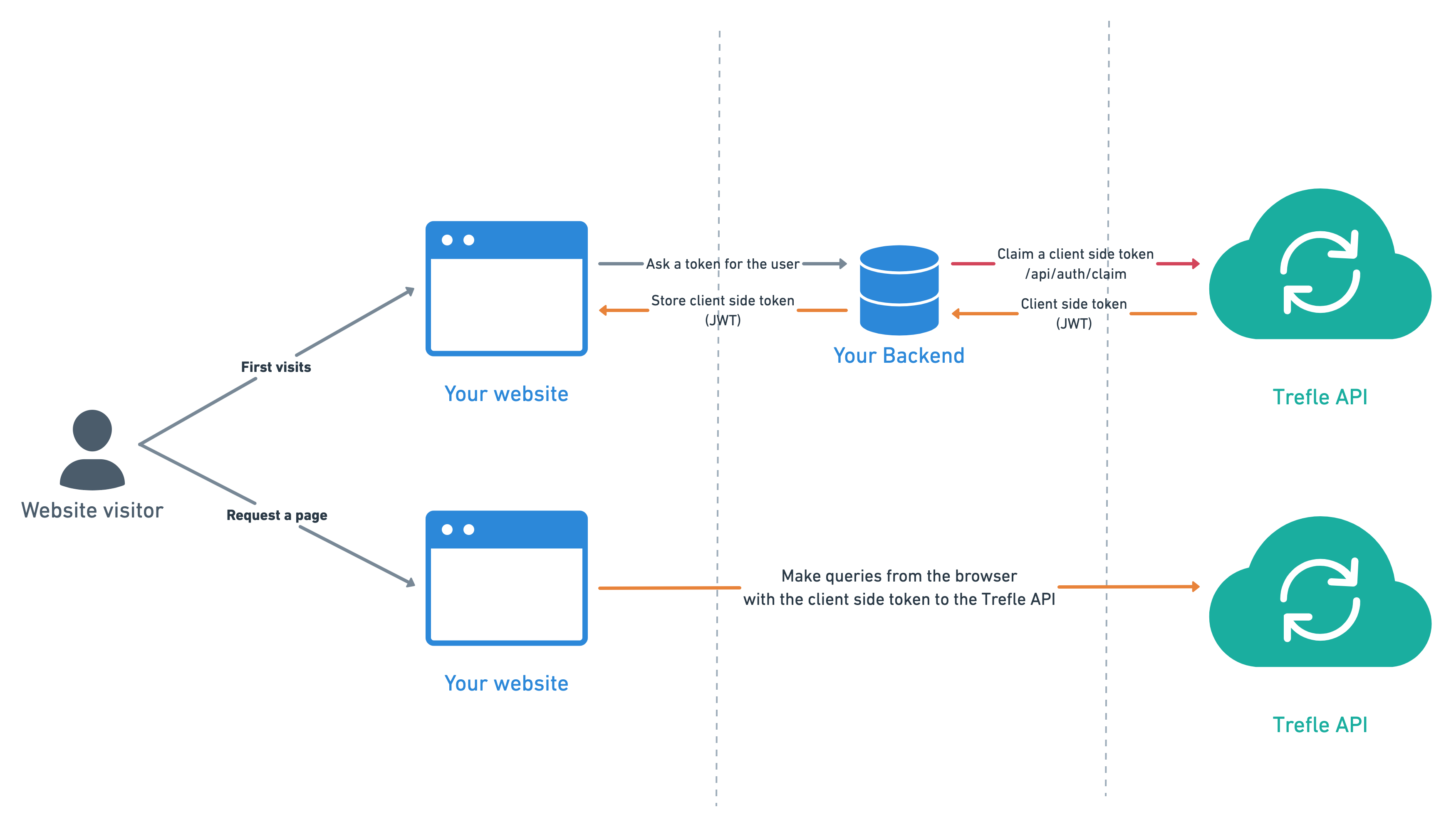
The claim call takes your secret access token and the origin the client-side requests will come from (scheme, host and port, such as https://YOUR-WEBSITE.example), and returns the JWT to use in the browser.
POST /api/auth/claim does accept cross-origin requests, but calling it from the browser would ship your secret access token to the client — which is exactly what the JWT exists to avoid. Make this call server-side.
Read requests (GET, HEAD) anywhere under /api, plus the POST /api/auth/claim call above. Write endpoints — submitting corrections or reports — are deliberately left out and still need to go through your own backend. Responses also expose the RateLimit-Limit, RateLimit-Remaining and RateLimit-Reset headers, so client-side code can read its remaining quota. From 2.9.8, Retry-After on a 429 is exposed too, so a browser client can read how long to wait.
Send your account token as a Bearer token and the origin in a JSON body. The ip field is optional (see below).
- CURL
- NodeJS
- Python
In your terminal:
curl -X POST 'https://trefle.io/api/auth/claim' \
  -H 'Authorization: Bearer YOUR_TREFLE_TOKEN' \
  -H 'Content-Type: application/json' \
  -d '{"origin": "https://YOUR-WEBSITE.example", "ip": "12.34.56.78"}'
Node 18 and later ship fetch, so no library is needed.
// Run this on your server, never in the browser.
const params = {
  origin: 'https://YOUR-WEBSITE.example',
  ip: 'THE-WEBSITE-USER-IP', // optional
};

(async () => {
  const response = await fetch('https://trefle.io/api/auth/claim', {
    method: 'POST',
    headers: {
      Authorization: `Bearer ${process.env.TREFLE_TOKEN}`,
      'Content-Type': 'application/json',
    },
    body: JSON.stringify(params),
  });
  const json = await response.json();
  console.log(json);
})();
import os
import requests

r = requests.post(
    'https://trefle.io/api/auth/claim',
    headers={'Authorization': f"Bearer {os.environ['TREFLE_TOKEN']}"},
    json={'origin': 'https://YOUR-WEBSITE.example', 'ip': 'THE-WEBSITE-USER-IP'},
)
print(r.json())
And we get:
{
  "token": "eyJhbGciOiJIUzI1NiJ9.eyJ1c2VyX2lkIjoxMDYsIm9yaWdpbiI6Imh0dHBzOi8vWU9VUi1XRUJTSVRFLmV4YW1wbGUiLCJleHAiOjE3OTE5OTQ0MDB9.signature",
  "expires_at": "2026-10-14T20:00:00Z",
  "expiration": "10-14-2026 20:00"
}
Read expires_at: an ISO 8601 timestamp in UTC. expiration holds the same instant in an older MM-DD-YYYY HH:MM format with no time zone. It is deprecated and kept only for existing clients.
In the browser, send the JWT the way you would send the account token, as the token parameter or in an Authorization: Bearer header. The origin you claimed must match the page's origin exactly, or the API answers 401.
Authorization: Bearer on this endpoint and the expires_at field arrive with API 2.9.8. Earlier versions answer 422 to the Bearer form and read the account token from a token parameter instead (POST /api/auth/claim?token=YOUR_TREFLE_TOKEN&origin=…), which 2.9.8 still accepts.
A JWT cannot claim another JWT: send your account token, or the call answers 401.
What the JWT protects, and what it does not
A JWT is a bearer token valid for 24 hours. Whoever holds it can use it until it expires.
- The origin check only applies when the browser sends an
Originheader. Browsers add it to cross-origin requests, so a JWT copied into another website is refused. A script, a mobile app orcurlsends noOrigin, and the API accepts the JWT from them. Binding anipat claim time narrows that down: the JWT is then refused from any other address. This is deliberate and will stay so: refusing every request without anOriginwould also refuse server-side rendering and the clients that already rely on it, while the JWT expires within 24 hours and spends its owner's quota. - Never embed your account token in a web page, a browser extension or a mobile app. Unlike a JWT it does not expire, and anyone who extracts it can claim JWTs of their own.
- Mobile apps send no
Origin, so an origin-bound JWT protects nothing there. Have the app call your own backend, and let the backend call Trefle with the account token. - Rate limit. Since 2.9.8, requests made with a JWT count against the account that claimed it: the account token and every JWT it claimed share one bucket per IP address. Claiming more JWTs does not raise your quota. See Rate limiting.
Renew the JWT from your backend before expires_at, and hand the new one to the page.
Putting the user remote IP in the claim API call is optional, but it provides an additional security layer. We don't keep or store this information.